We can’t fix SA if we don’t fix Joburg

South Africa cannot restore growth, expand opportunity and attract investment while Johannesburg continues its disastrous decline. Preventing the collapse of the city must become a national priority.
Cities are central to a country’s growth and development. Johannesburg remains the heart of the country’s financial and corporate economy, the source of the largest share of tax revenue, and a critical arena of employment, investment and opportunity. It is South Africa’s principal economic gateway to the world and sits at the heart of the country’s urban system.
Johannesburg’s multiplying crises are no longer simply a local government problem. It is the one municipality whose failure would make national success impossible. If Johannesburg cannot be fixed, can we fix South Africa?
It has historically been South Africa’s great arena of opportunity, drawing in people from across the country, and the region, in search of work and a better life. As the city becomes less able to perform that role, opportunities to get out of poverty become more restricted for millions.
There are two central aspects of urban management that all cities need to get right. The first is property development: creating an environment in which developers, businesses and households want to invest in the city so that they pay the rates and taxes required to fund infrastructure and service delivery.
The second is poverty alleviation: connecting poor people to the opportunities created by an expanding urban economy. Cities should be judged not by how many poor people live in them, but by how quickly they are able to move out of poverty.
Johannesburg is failing on both tests. Municipal dysfunction ensures that property development is in decline, that higher-income households are under pressure, and that the poor suffer the most through lack of access to well-located, affordable housing, to jobs, and to skills acquisition. Over the past 10 years Johannesburg recorded a cumulative house price decrease of 2%, compared with an increase of about 60% in Cape Town.
The spatial characteristics of poverty and joblessness remain firmly entrenched. And fewer people from beyond Johannesburg are gaining access to the economic opportunities that well-run cities provide: the city’s population growth rate has slowed noticeably since around 2010, which probably reflects its declining attractiveness as a destination for rural and small-town migrants.
The city is failing across every dimension of its mandate. It is in severe financial distress. The minister of finance, Enoch Godongwana, has warned that the city owes creditors R25.2bn but holds only R3.9bn in cash and cash equivalents. Johannesburg Water has identified an infrastructure renewal backlog of R26.6bn, and at the current pace, fully replacing the city’s ageing pipe network would take close to two centuries. There is an estimated electricity infrastructure backlog of R44bn, and the city recorded 54,132 power outages between July and December 2025.
Johannesburg has the highest official unemployment rate among South Africa’s metros. Between April 2025 and June 2026, it lost 90,000 jobs. Cape Town, by contrast, gained 57,000.
Poor governance weakens municipal finances; weak finances undermine maintenance and investment; failing infrastructure raises the cost of doing business; businesses and skilled people leave; and a weakening economy makes the city’s finances still harder to repair. The failure of Johannesburg jeopardises its potential role as anchor for a national system of successful cities.
Since 2016 it has had nine mayors and been run by eight different coalitions. No mayor completed a full five-year term. Stable long-term planning has all but disappeared, while appointments, priorities and policies have shifted with the political winds.
The city’s crisis is primarily political.
The November local government elections are therefore critical to Johannesburg’s future. A continuation of the current political and governance dysfunction would deepen and probably accelerate the city’s decline. A weak and unstable coalition would struggle to take difficult decisions, appoint capable people, attract partners and investors or sustain a multi-year programme of reform. The choice facing voters is a stark and vitally important one.
Johannesburg can recover. But we have to fix what has been broken, and the fundamental functions of government must be rebuilt for the city to become a place of opportunity, economic dynamism and new development that all its residents and the country so desperately need. This will only be possible if the elections produce stable, honest political leadership, and if that leadership then mobilises the best possible people, including from outside political parties, to manage reform and delivery.
Even then, capable new leadership will not be able to fix Johannesburg alone. Success will require effective partnerships that build on the city’s many extraordinary assets, including its vibrant private sector, deep financial markets, many educational institutions, and its dynamic citizens and civic organisations. These assets provide the basis for recovery — but only if they are matched by effective governance and bold reforms. The chances of success will also require a special response from the national government.
Amid the gloom, it is important to hold on to the enormous potential of Johannesburg: a place where young people can build a future, businesses can expand, new start-ups emerge, and people can live and see their families prosper.
A thriving Johannesburg would be a powerful engine of growth for the country, driving employment and upward mobility. The opposite is also true: a failing city will drag South Africa down, as it has been doing for some time.
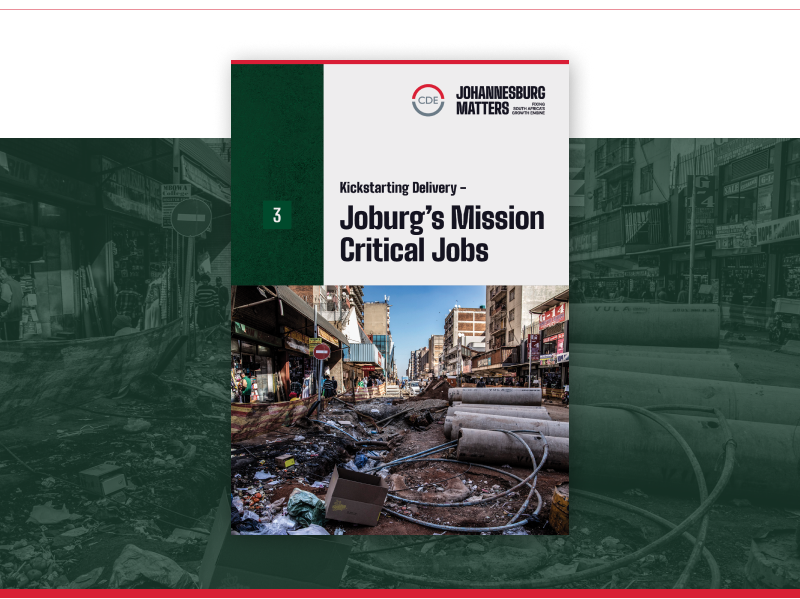
Bernstein is executive director of the Centre for Development & Enterprise. This article is based on ‘Joburg in Jeopardy’, the first report in ‘Johannesburg Matters: Fixing South Africa’s growth engine’, a new CDE series.
This article was published on Sunday Times