MEDIA RELEASE | The first test of Joburg’s new government will be who it appoints

Johannesburg will not be fixed unless its next government puts capable people in charge of the institutions responsible for running the city.
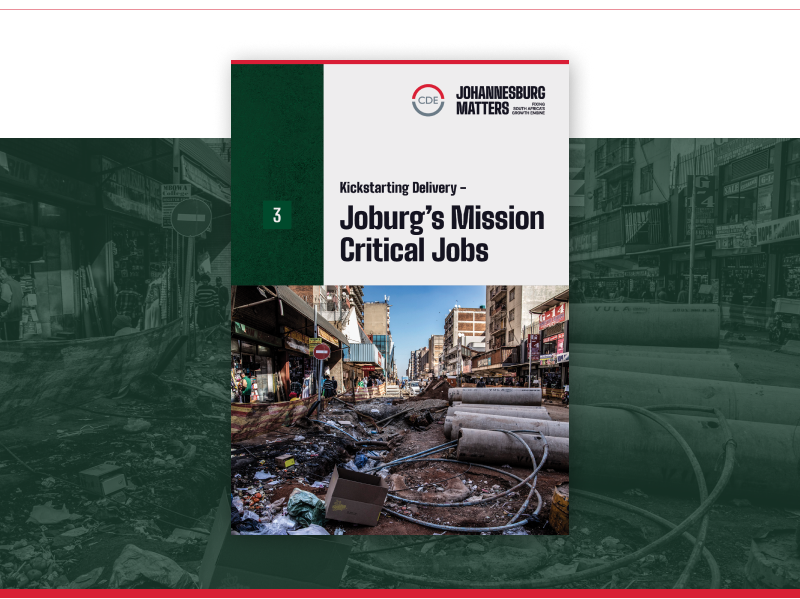
That is the central argument of Kickstarting Delivery – Joburg’s Mission Critical Jobs, the third report in the Johannesburg Matters series by Centre for Development and Enterprise (CDE) released today.
“The first test of the government elected in November will be who it appoints to run Johannesburg,” said CDE executive director Ann Bernstein. “No turnaround strategy will succeed if the institutions responsible for implementing it remain weak, politicised and poorly led.”
The City’s management crisis is severe.
Since 2016 Johannesburg has had nine mayors and eight coalition administrations. At the top of municipal entities, political allegiance has generally taken precedence over the skills and experience required for the job, resulting in frequent turnover of boards.“
None of the members of the Johannesburg Water board is a professionally qualified engineer, while at least seven of the City’s 24 most senior management positions are occupied by acting appointees.
Johannesburg’s own annual reports point to persistent vacancies among engineers, finance professionals, ICT specialists, project managers and supply-chain experts.
“City departments and utilities cannot continue to operate as political fiefdoms,” Bernstein said. “Senior appointments and board positions are not bargaining chips to be divided among coalition partners.”
What the next government should do
CDE argues that the incoming administration should make getting the right people into the most important jobs one of its priorities.
- Get the appointment of the City Manager right. Johannesburg needs a highly capable city manager selected through a rigorous, transparent and competitive process that is premised on a recognition of the enormity of the turnaround challenge facing the City.
- Put capable, independent people in charge of the utilities. Start with Johannesburg Water, City Power and Pikitup each of which need boards with the technical, financial and management expertise required to oversee complex infrastructure businesses. Those boards (or the core of a new board built around an experienced appropriate chairperson) must in turn ensure that highly capable CEOs are in place and then hold those management teams accountable for results.
- Identify the City’s mission-critical positions and conduct an immediate audit of who occupies them, preferably before taking office. Test to see who the incumbent is, their appointment date, contract type and when it expires. Vacancies and acting appointments in critical positions should then be filled urgently, with particular emphasis on engineering, finance, ICT, project management and procurement expertise. Where capable officials are already doing good work, the City should retain and support them. Where senior officials cannot perform at the level required, the City should use the mechanisms available under existing employment law, and detailed in the report, to address the problem fairly but quickly.
CDE is calling on political parties contesting the November election to commit publicly to transparent, competitive appointments based on competence, experience and integrity—and to keeping political office-bearers out of procurement, appointments and operational decisions. If there is a coalition, this commitment must be a non-negotiable component of the coalition agreement.
“It is vital that Johannesburg breaks the link between political change and administrative appointments. Senior appointments and board positions cannot continue to be treated as political bargaining chips,” said Bernstein.
“Cadre deployment is deeply entrenched in Johannesburg’s entities and administration,” added Bernstein. “They have become fiefdoms, each controlled by a different political faction and managed accordingly.”
Some interventions can’t wait for lengthy recruitment processes, the outcomes of which are uncertain. For example, where infrastructure is at risk of further collapse, a new administration may need to bring in independent technical and professional expertise for specific, time-limited assignments while permanent leadership is being put in place. These arrangements must be subject to agreed targets, full transparency and clear accountability.
“Johannesburg cannot be fixed overnight, and getting the right people in place will take time,” said Bernstein. “But some of the City’s challenges need urgent action to prevent further deterioration or infrastructure collapse. In this context innovative, speedy and unusual interventions might well be required.”
“Appointing capable people will not repair a water pipe or solve the City’s financial problems overnight,” said Bernstein. “But none of the wider reforms required to turn Johannesburg around will succeed if the institutions responsible for implementing them remain weak, politicised, plagued with corruption and poorly led. People trump policy.”
The November election will therefore be about more than electing a mayor. It will determine whether Johannesburg begins the difficult task of replacing government by patronage with government by competence.
Kickstarting Delivery – Joburg’s Mission Critical Jobs is available here.
For media enquiries and interview requests, please contact Refiloe Benjamin: media@cde.org.za | 079 863 6134
Media materials
- Ann Bernstein’s picture, here.
- Kickstarting Delivery – Joburg’s Mission Critical Jobs cover image, here.
- Image used on the cover (please credit Mark Lewis), here.
ABOUT JOHANNESBURG MATTERS: Fixing South Africa’s growth engine
Johannesburg Matters: Fixing South Africa’s growth engine is a new series of reports from the Centre for Development and Enterprise, based on a large research programme into the major challenges confronting the city. The series will provide analysis and recommendations that a new political leadership and reformed administration could implement after the elections as they commence the difficult job of rebuilding South Africa’s most important urban centre.
ABOUT THE CENTRE FOR DEVELOPMENT AND ENTERPRISE
CDE is an independent policy research and advocacy organisation. It is South Africa’s leading development think tank, focusing on critical development issues and their relationship to economic growth and democratic consolidation. Through examining South African realities and international experience, coupled with high-level forums, workshops and roundtables, CDE formulates practical policy proposals outlining ways in which South Africa can tackle major social and economic challenges. CDE has a special focus on the role of business and markets in development.