The Procurement Trap: An economic perspective on the draft general public procurement regulations
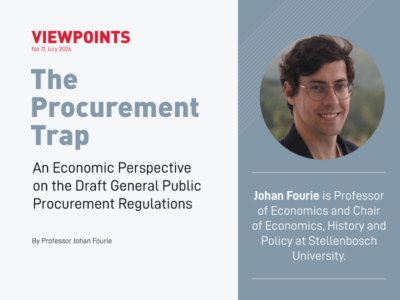
- Written by Professor Johan Fourie, Chair of Economics, History and Policy at Stellenbosch University, this CDE Viewpoints report assesses the draft General Public Procurement Regulations and argues that South Africa’s procurement system needs stronger institutional capacity rather than more complex regulation.
- South Africa spends almost R1 trillion a year on public procurement. Improving how this money is spent is essential for better infrastructure, service delivery and public trust.
- The draft General Public Procurement Regulations introduce important improvements, including stronger transparency, mandatory publication of procurement plans and contract awards, and a more coherent procurement framework. These reforms should be retained.
- The report argues that the regulations rely too heavily on detailed legal rules, ownership-based set-asides and pre-qualification requirements, while South Africa’s biggest procurement challenge is weak institutional capacity rather than a lack of legislation.
- International evidence shows that procurement outcomes depend more on capable institutions than on increasingly complex rules. Uniform rules applied to all contracts can reduce competition, increase costs and delay delivery, particularly for large and complex projects.
- Blanket set-asides and ownership-based pre-qualification may expand participation by targeted firms but also risk increasing cost overruns, slowing project delivery and encouraging supplier dependence rather than building competitive businesses.
- Professor Fourie’s Viewpoints report recommends redesigning the regulations before they are finalised by tailoring procurement rules to contract complexity, piloting new measures before wider implementation, strengthening open procurement data, and introducing regular performance reviews of the system.