Dada Morero in conversation with Ann Bernstein
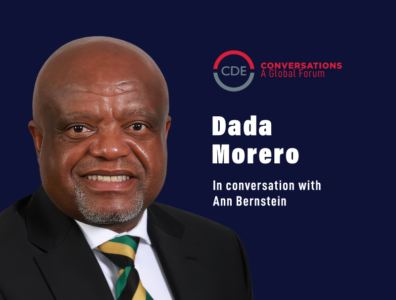
- Dada Morero, the Executive Mayor of Johannesburg, joined Ann Bernstein to discuss the state of the city and his record in office. This was the second of two special CDE Conversations with representatives of the two largest parties ahead of the 4 November local government elections.
- Morero said his administration had prioritised bylaw enforcement, financial stability and basic service delivery. He pointed to a bigger maintenance budget, capital raised for infrastructure, and the rating agencies’ recent move to a positive outlook for the City.
- He acknowledged a R220 billion infrastructure backlog, the result of years of underinvestment and rapid urbanisation. He said the City was raising money from development finance institutions to replace ageing substations and water pipes.
- He said ring-fencing was working. Under the 70-30 split, the utilities keep 70% of the revenue they collect. The split is in place at Joburg Water and being piloted at City Power, with the aim of moving gradually towards the entities keeping all of the revenue.
- He said the City had settled its R5.25 billion debt to Eskom in full, paid for by better collections at City Power, which was acknowledged by Eskom in August. However, according to JoburgCAN, a summary of City Power’s payments to Eskom circulated to City stakeholders showed an outstanding balance of almost R10 billion at the end of September 2026. JoburgCAN says, “It remains unclear how much of this represents historical arrears, how much relates to current electricity accounts and whether the July account was paid as promised”.
- He defended the wage settlement with SAMWU, worth more than R10 billion, as correcting long-standing pay disparities. He said National Treasury had agreed to withdraw its claim that the deal was unlawful. However, there is no public record of this.
- In response to Ann Bernstein’s concern that organisations like Johannesburg Water, a multi-billion-rand operation with massive projects, has not one qualified engineer on the board, Morero explained that he initiated a policy change to improve the quality of boards, which will be implemented in 2027. He did not answer the question about what the previous policy was, which did not require experienced engineers on Joburg Water’s board or why it has taken so long to address this?
- On corruption, Ann Bernstein asked the mayor why the Group Forensic and Investigative Service (GFIS), which was investigating 6,000 cases involving some R30 billion at the time, was placed under the control of the City Manager in 2023 and its work declared null and void. Morero defended the council’s decision. He argued that there were serious irregularities at GFIS and that irregular expenditure does not necessarily mean theft.
- He accepted that residents’ frustrations over water and power failures were legitimate but urged them to recognise progress. As an example he cited a new 26-megalitre reservoir that has ended water interruptions in Coronation and surrounding areas near Selby.