MEDIA RELEASE | Misplaced focus on public employment schemes perpetuates unemployment crisis
South Africa has the deepest and most persistent unemployment crisis in the world. Despite this, government continues to avoid the essential reforms that would change the country’s trajectory. Instead, it continues to rely on piecemeal public employment initiatives such as the Presidential Employment Stimulus or the Expanded Public Works Programme that will never shift the needle on unemployment.
The time has come to start talking about what a labour absorbing economy looks like, and what it would take to get us there. This includes making difficult decisions about the rigidities that hobble the labour market, the failure of skills development programmes, and the many barriers in the way of small and informal businesses.
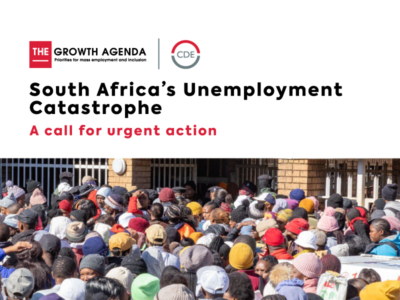
This is the central message of a new report by the Centre for Development and Enterprise (CDE), South Africa’s Unemployment Catastrophe: A call for urgent action.
“More than 12 million South Africans want work but cannot find a job. For 17 years, 1 000 people have joined the unemployment queue every day,” said Ann Bernstein, executive director of CDE.
Over nearly two decades, South Africa’s labour force grew by 42 per cent, while total employment increased by barely 15 per cent. The result: millions more work-seekers chasing far too few opportunities.
CDE’s report highlights a range of major failures that have stifled growth, and, therefore, job-creation: the collapse of state-owned companies such as Eskom and Transnet; a deepening fiscal crisis; high levels of corruption; municipal collapse; and badly conceived and implemented economic transformation and industrial policies.
“Each of these failures on its own would have slowed growth. Together, they have collapsed growth to little more than zero. And when an economy doesn’t grow, nor does the number of jobs,” said Bernstein. “Economic growth is by far the most potent lever for reducing unemployment.”
CDE’s report shows that public employment schemes such as the Expanded Public Works Programme, Community Works Programme and the Presidential Employment Stimulus are no substitute for structural reform.
“Public employment schemes provide only temporary relief and will never generate the millions of jobs South Africa needs,” said Bernstein.
She added that: “In the past 15 years, both government and organised business have focused far more energy on special projects and youth initiatives that create a very limited number of jobs than they have on the hard work needed to achieve policy reform to create millions of market based jobs.”
CDE estimates that average growth of 4 per cent would create around 400 000 net new jobs a year. Combined with bold new reforms to make growth more labour-intensive, South Africa could expand employment by millions within a decade.
But the country is hamstrung by a lack of political will.
“President Ramaphosa seems unable to make the tough choices necessary to grow the economy and create jobs for the millions of unemployed. The country desperately needs bold and resolute leadership willing to confront vested interests and embrace the changes that are required,” said Bernstein.
According to CDE, government needs to urgently introduce a package of serious reforms in four key areas:
- Labour market reform
South Africa’s labour market rules raise the cost of hiring and make it harder to employ unskilled and inexperienced workers. Our wage-setting machinery empowers large firms and unions at the expense of small businesses, while bargaining council agreements are extended to firms that never signed them. By the National Minimum Wage Commission’s own estimation, the national minimum wage has destroyed almost 100 000 jobs.
CDE recommends:
- Amending the Labour Relations Act (LRA) to allow a 12-month probation period during which dismissal is restricted only for automatically unfair reasons such as racial discrimination.
- Stopping the extension of bargaining council agreements to firms not party to them, and exempting small, new and labour-intensive firms.
- Removing restrictions on labour brokers, whose services help expand opportunities and create entry points for people with no other connections to the labour market.
- Fixing the skills system
Every year, South Africa spends tens of billions on skills development. But outcomes are dismal. SETAs are widely regarded as dysfunctional, while most Technical and Vocational Education and Training Colleges (TVETs) fail to provide young people with skills that employers need.
CDE recommends:
- Scrapping the SETAs and redirecting energies towards employer-driven apprenticeships and private high quality training aligned with business needs.
- Overhauling TVET colleges with results based funding and by aligning curricula with business requirements, strengthening industry partnerships, and incorporating work-based learning.
- Unleashing the dynamism of small business
Small and new firms should be engines of job creation, but South Africa’s current approach is not working. One of the more regulated environments in the world stifles small business and too often new laws and regulations raise costs instead of reducing them. We need a new approach that moves small business support, funding and development to the private sector and away from the state.
CDE recommends:
- Enabling small firms to inform regulators what are the most important rules that hold back their progress – a bottom up process; and using this information to simplify/remove existing regulations that impose unnecessary costs on small businesses
- Funding private institutions to lead the country on how best to promote dynamic new and expanding small firms. This should be done through a competitive process and considerable rigour on transparency and public reporting to ensure impact.
- Removing obstacles to informal sector growth
South Africa’s informal sector is unusually small. Informal jobs are precarious and low-paid, but they play an essential role in poverty alleviation in countries around the world. Instead of enabling these activities, government’s predominant approach is characterised by disdain and hostility.
CDE recommends:
- Consulting informal firms when assessing regulations that stifle growth
- Encouraging city governments to zero rate licenses for street traders
- Exploring the possibility of providing informal traders with transport subsidies
- Promoting densification of cities so that more small, informal firms can flourish, by
- Freeing up small housing developers
- Making state land available for low-cost housing
- Developing a new housing policy that will create access to housing in dense, economically viable parts of the city
“South Africa’s institutional environment pushes up the cost of employment and locks millions out of work,” said Bernstein. “We shouldn’t romanticise the informal economy, but we need to create more space for people to find their own livelihoods.
“The choice before South Africa is stark. We can act with urgency, embrace reform and create a pathway to inclusive prosperity with millions more jobs, or we can condemn another generation to the despair and anger of joblessness. The time for hesitation, compromise and prevarication has long gone. The time for reform is now,” concluded Bernstein.
For media enquiries, please contact Refiloe Benjamin: media@cde.org.za | 011 482 5140
ABOUT THE CENTRE FOR DEVELOPMENT AND ENTERPRISE
CDE is an independent policy research and advocacy organisation. It is South Africa’s leading development think tank, focusing on critical development issues and their relationship to economic growth and democratic consolidation. Through examining South African realities and international experience, coupled with high-level forums, workshops and roundtables, CDE formulates practical policy proposals outlining ways in which South Africa can tackle major social and economic challenges.