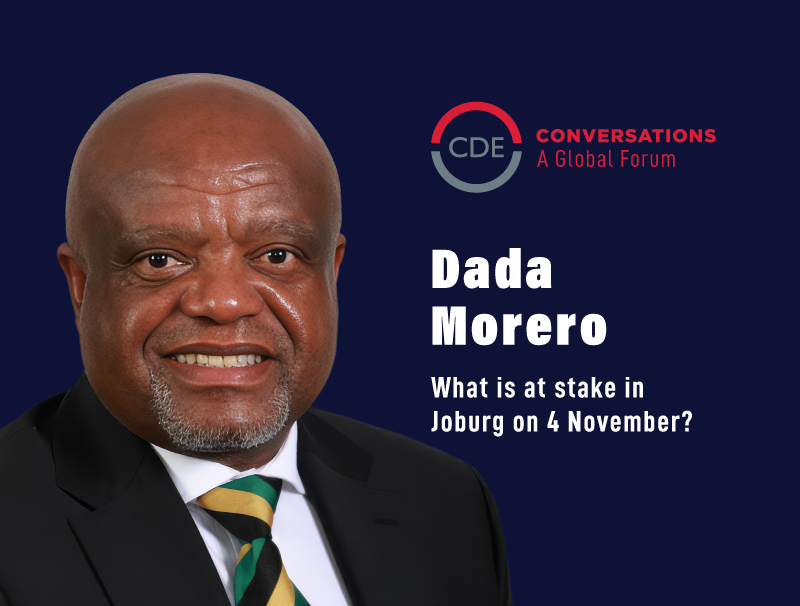
Joburg needs radical transparency

Johannesburg desperately needs better leadership. After years of unstable coalitions, revolving mayors, politicised appointments, division of the city’s entities and departments into political fiefdoms, deteriorating services and deepening financial distress, that proposition seems unarguable.
But, important as it is, leadership is not the only thing Joburg needs. A city of nearly 6-million people, with a municipal budget that is approaching R100bn a year, cannot depend for its integrity on the hope that the right people will always occupy the right offices. It needs something more durable: institutions that are designed to work even when some of the people running them are incompetent, compromised or actively trying to repurpose them for improper goals.
This is the key lesson emerging from research the Centre for Development & Enterprise (CDE) commissioned from the Global Initiative Against Transnational Organised Crime (GI-TOC), which sets out in depressing detail the emergence of a “crime-council ecosystem” in the city, characterised by intersecting political, commercial and criminal interests around procurement, appointments and service delivery.
They point to examples of politically influenced boards and senior appointments that facilitate the manipulation of tenders for personal and party gain, and to corrupt municipal insiders who collude with criminals engaged in infrastructure theft, sabotage, building hijacking and extortion.
Not every failure in Johannesburg is caused by corruption, of course. Old infrastructure, weak management, inadequate maintenance, fiscal pressure and straightforward incompetence account for some of the potholes and power outages Joburgers experience.
But individual and political party corruption is entwined with those failures in ways that complicate reform. Most troublingly, dysfunction itself can create opportunities for profit when, for example, a broken water system creates demand for tankers. The worse the system performs, the more opportunities arise for people to profit from dysfunction.
This changes the nature of the problem, because if Joburg were simply suffering from inadequate rules, the solution would be better rules. If the problem were ignorance, officials could be trained. If it were primarily a shortage of ethical awareness, (yet) another integrity campaign might help.
But there is no shortage of procurement rules or codes of conduct or anti-corruption legislation. Instead, we have a situation in which the institutions responsible for applying those rules can themselves be manipulated, weakened or bypassed. Reform must begin from an uncomfortable assumption: that powerful people will have strong incentives to defeat whatever anti-corruption systems are created.
Reforms that ignore that reality will likely fail. Consider procurement: Johannesburg spends about R20bn a year buying goods and services from outside providers. Traditionally, governments have tried to control procurement through internal processes. Those remain necessary. But if corrupt insiders — board members, officials, politicians — control and distort the application of those rules, internal controls cannot be the entire answer.
The city must therefore adopt a policy of radical transparency for all procurement decisions in relation to significant contracts: citizens should be able to see the specifications, the bidders, the bid adjudicators, the bid scores, any disqualifications, the beneficial owners of winning companies and major subcontractors, any deviations from normal procedures, any contract variations, invoices, payments and proof that the goods were actually delivered.
The principle is simple: don’t rely exclusively on officials to police other officials. Radical transparency multiplies the number of independent pairs of eyes scrutinising tenders and procurement. But sunlight alone cannot eliminate corruption. We need other reforms, too. Greater transparency in appointments, for example.
Johannesburg’s municipal entities control significant budgets and deliver critical services. Their boards and senior executives therefore matter enormously. In previous reports the CDE has shown how political influence over these appointments has weakened the firewall between political oversight and operational management.
The answer must be processes that ensure appointments become harder to manipulate. The city must publicly commit to merit appointments. This process requires open recruitment, published criteria, independent professional assessments of candidates and reasons for decisions recorded. The more power a position exercises over money and contracting, the stronger those protections should be.
A similar logic applies to investigations. Johannesburg’s Group Forensic & Investigation Services (GFIS) investigated more than 6,000 matters involving transactions worth R35bn. It was also subjected to intense political pressure, and in 2023 the city adopted a report declaring earlier GFIS investigations and findings “unlawful, null and void” and placed the organisation under the city manager.
That raises a fundamental question: what happens when the people who control an investigative body are themselves suspected of wrongdoing? We recommend an automatic system for escalating investigations. For example, serious allegations involving people who might have influence over GFIS should automatically trigger, at a minimum, notifications of investigations to external bodies such as the auditor-general or the Special Investigating Unit (SIU) so that they cannot simply “disappear”.
Similarly, investigative findings should be tracked until they are acted upon, and officials who decline to implement recommendations must be required to explain why. These steps would eliminate some discretion, making processes less vulnerable to abuse.
In criminal investigations the city cannot replace the Hawks, police, National Prosecuting Authority or SIU. But it need not hand every potential investigation over to the police and then forget about it. It has powers and legal remedies of its own, and needs to take what actions it can: firing officials or the pursuit of civil remedies to recover funds paid in respect of corrupted contracts.
Investigations and civil actions must create a credible expectation that wrongdoing will have serious consequences for those involved. They should risk losing their contract, their job, their money and, where criminal conduct can be proved, their freedom.
But none of this will work if people are too frightened to speak. The Johannesburg research describes intimidation of investigators and whistle-blowers, including an environment around GFIS characterised by one interviewee as involving “fear, intimidation and threat to life”. In 2024 an investigator for GFIS, Senza Sithole, was shot and killed in his car in the CBD, joining a growing list of auditors, liquidators and other investigators in Gauteng who have been murdered.
Secure reporting channels and protection against retaliation are critical for facilitating whistle-blowing. So too is a recognition that sometimes steps will have to be taken to protect the physical safety of whistle-blowers. Consideration should also be given to rewarding whistle-blowers if their information results in successful action that saves (or leads to the recovery of) money.
No one intervention will fix Johannesburg. A procurement portal will not do it. Nor will lifestyle audits, an independent forensic unit, better appointments or a stronger relationship with the criminal justice system. The truth is that the problem is too deeply embedded for a single silver bullet.
Johannesburg needs an architecture of mutually reinforcing protections: senior appointments that are harder to manipulate and where professionalism and integrity are the most important criteria; transparency that makes corruption harder to hide; investigations that are not easily stalled by implicated officials; and whistle-blowers who feel safe.
A determined mayor and capable administration could make enormous progress in rebuilding Johannesburg. The forthcoming election therefore matters profoundly: if it brings in a reforming mayor who uses the tools available to clean up, the city will have a fighting chance of recovery. If that doesn’t happen, it’s hard to see how they will deliver on all their other promises.
• Bernstein is executive director of the Centre for Development & Enterprise. This article is based on Time for Action — Corruption in Joburg, the fifth report in a new CDE series, Johannesburg Matters: Fixing South Africa’s Growth Engine.
This article was published on Business Day