MEDIA RELEASE | Joburg’s crime-council ecosystem and how to break it
Johannesburg’s decline has been exacerbated by corruption that robs the city of the resources needed to maintain and expand infrastructure. Worse, it has been exploited by people who profit from keeping the City broken. Infrastructure theft creates contracts for repairs. Water failures create demand for tankers. Dysfunction creates opportunities for emergency procurement. Those who benefit from failure therefore have an interest in perpetuating it.
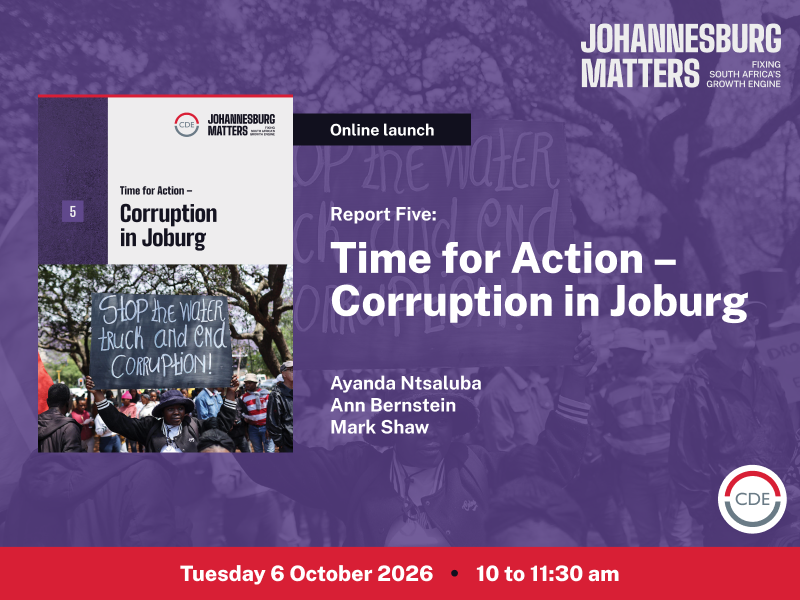
This is the warning put forward in Time for Action – Corruption in Joburg, a new report launched by the Centre for Development and Enterprise (CDE) today, the fifth in CDE’s Johannesburg Matters: Fixing South Africa’s growth engine series.
“The diagnosis is stark,” said CDE executive director Ann Bernstein. “Johannesburg is not suffering only from weak administration, poor maintenance or ordinary municipal incompetence. It has also developed a ‘crime-council ecosystem’ in which political, business and criminal interests intersect around the machinery of local government and benefit from dysfunction.”
The report draws on research commissioned by CDE from the Global Initiative Against Organized Crime (GI-TOC) and released simultaneously. That report describes overlapping networks operating around municipal procurement, appointments and services such as electricity, water and property.
The GI-TOC research shows how political influence over municipal entities and senior appointments is used to facilitate tender manipulation. In addition, corrupt insiders collude with criminals involved in infrastructure theft, sabotage and building hijacking.
“Violence and intimidation are used extensively to protect corrupt interests and threaten investigators, whistleblowers, politicians and legitimate businesses,” said Bernstein.
This system has flourished and deepened alongside persistent institutional instability, and in particular, the lack of continuity of metropolitan governments, while, at the same time, processes used to ensure transparency and accountability have been weakened.
The watchdog that was neutered
The City’s own anti-corruption capacity has been badly weakened.
The Group Forensic and Investigation Services (GFIS) was launched in November 2016 to provide effective fraud risk management. It investigated over 6 000 cases involving transactions worth R35 billion but faced sustained political pressure. In June 2023, the City adopted a report declaring all previous corruption probes and forensic findings conducted by GFIS to be ‘unlawful, null, and void’, and handed the watchdog’s powers to the City Manager. The subsequent assassination of a forensic investigator has had a chilling effect on internal reporting because the environment has become dominated by ‘fear, intimidation and threat to life’.
Assume vested interests will fight back
The lesson CDE draws from this is that Johannesburg cannot address deep-seated corruption by issuing better rules, demanding improved compliance or insisting on more ethical behaviour.
“The objective cannot be to develop yet another municipal anti-corruption strategy with worthy intentions,” said Bernstein. “Johannesburg has to make corruption harder to conceal, easier to detect and much more likely to result in consequences.”
Reformers must, therefore, assume that powerful interests, inside and outside the City’s structures, will try to defeat new systems and policies. It follows that reforms should favour mechanisms that are automatic, transparent and externally verifiable over mechanisms that rely on the discretion of individual officials.
Ten priorities for action
CDE highlights several immediate priorities for a new administration:
- Make procurement radically transparent. Publish information across the full life cycle of major contracts, from specifications and bid scoring to beneficial ownership, contract variations, invoices, payments and proof of delivery. Use City data to identify suspicious connections and procurement patterns.
- Make political appointments harder to manipulate. Introduce open, merit-based processes for senior positions and municipal entity boards, with published criteria, professional assessment and recorded reasons for appointments.
- Attack the economics of organised crime. Reduce opportunities to profit from infrastructure theft, sabotage and emergency procurement, including through less theft-prone infrastructure, tighter controls on emergency contracts and stronger supplier performance rules.
- Use lifestyle audits strategically. Require appropriate financial and conflict-of-interest disclosures for officials in high-risk positions and concentrate lifestyle audits where corruption risks are greatest, with proper privacy and legal safeguards.
- Give investigators real independence. Strengthen GFIS and protect its leadership, budget and investigations from political interference. Sensitive investigations should trigger automatic external referral or oversight, and completed findings should be formally tracked so that they cannot simply disappear.
- Target the criminal networks doing the most damage. Concentrate scarce investigative resources on repeat suppliers, politically connected intermediaries, officials linked to multiple suspect transactions, infrastructure syndicates, organised extortion and major procurement corruption.
- Mobilise the criminal justice system. Prioritise serious and repeat offenders, build stronger cases, refer them systematically to the appropriate law-enforcement agencies and track what happens after referral.
- Make investigations lead to consequences. Use disciplinary action, civil recovery, contractual remedies and anti-corruption law alongside criminal prosecution. The City should recover losses and impose consequences rather than allowing forensic reports to gather dust.
- Protect and incentivise whistleblowers. Establish secure reporting channels, protect whistleblowers against retaliation, create rapid referral mechanisms where physical safety is threatened and consider carefully designed rewards for information that results in substantial recoveries or successful enforcement.
- Change the culture. In the public sector, systems making corruption difficult, visible and dangerous for perpetrators have more impact on organisational culture than ‘culture-focused’ interventions.
“A forensic report gathering dust in an office is not an anti-corruption achievement,” Bernstein said. “Investigations have to end in consequences.”
The underlying principle is simple: Johannesburg needs institutions capable of functioning even when powerful people have an interest in defeating them.
“There is no shortage of ethical codes, procurement rules, financial regulations or declarations of principle in South African government institutions. The problem is the gap between rules and outcomes.
“Johannesburg desperately needs leaders committed to dealing with corruption and criminality in and around the administration and its politics. The dangers of more of the same for the next five years are immense. The November elections are an opportunity to put Johannesburg on a better path. Voters should seize it,” she added.
Time for Action – Corruption in Joburg is available here.
Joburglary is available here.
For media enquiries and interview requests, please contact Refiloe Benjamin: media@cde.org.za | 079 863 6134
ABOUT JOHANNESBURG MATTERS: Fixing South Africa’s growth engine
Johannesburg Matters: Fixing South Africa’s growth engine is a new series of reports from the Centre for Development and Enterprise, based on a large research programme into the major challenges confronting the city. The series will provide analysis and recommendations that a new political leadership and reformed administration could implement after the elections as they commence the difficult job of rebuilding South Africa’s most important urban centre.
ABOUT THE CENTRE FOR DEVELOPMENT AND ENTERPRISE
CDE is an independent policy research and advocacy organisation. It is South Africa’s leading development think tank, focusing on critical development issues and their relationship to economic growth and democratic consolidation. Through examining South African realities and international experience, coupled with high-level forums, workshops and roundtables, CDE formulates practical policy proposals outlining ways in which South Africa can tackle major social and economic challenges. CDE has a special focus on the role of business and markets in development.